My work world is 100% dedicated to computers and technology. My personal world is not. So here is how I am trying to get the best of both worlds…and how it’s working.
Questions I want to answer
- Ultimately, what equipment do I need for improving connection strength and quality the further out I go?
- Is a HotSpot worth the investment?
- Is the antenna in my iPhone better for signals than a HotSpot?
- How much do Cellular boosters really help and when to use it?
- How much do MIMO antennas really help and when to use it?
- Should I invest in Satellite internet?
- Is there a point of no return?
Assumptions
- I did not want to go beyond $1,000.00 for equipment nor increase my monthly bill > $50
- I prioritized 4G networks and devices
- Because 5G is newer and lacking infrastructure, I tracked it but didn’t prioritize it
- Because 3G is end of life, I didn’t track it
- Because Starlink does not support mobile yet and it is expensive, I did not invest in it
Logical Architecture
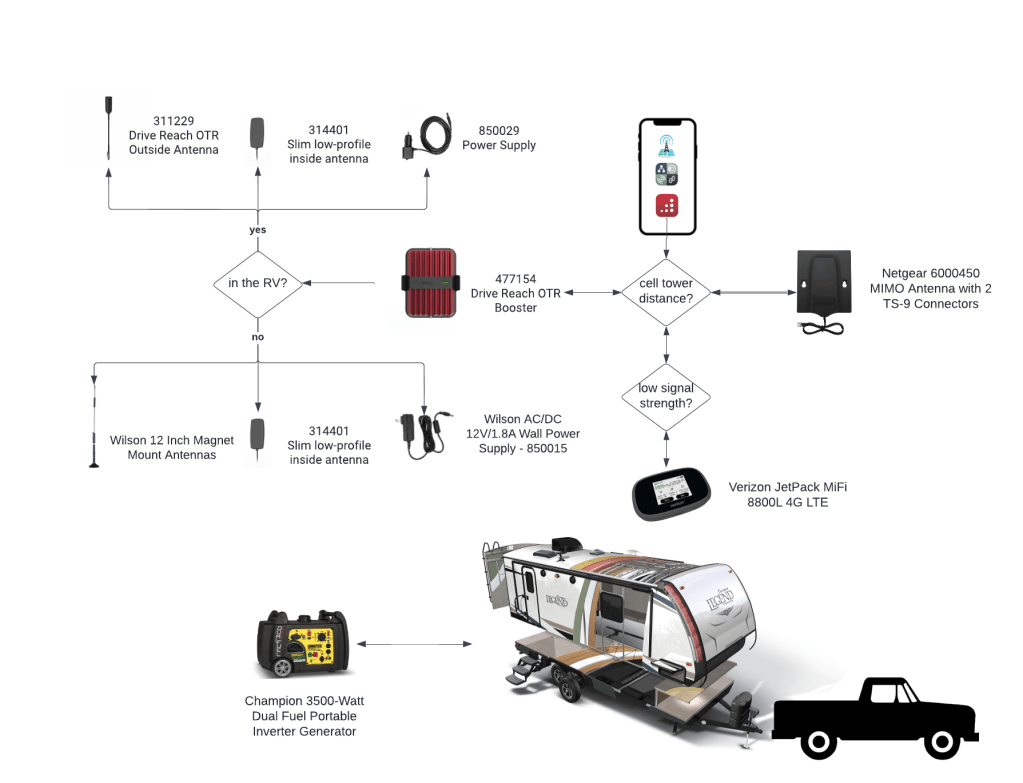
Something I learned
- Bars don’t really indicate strength and quality.
- You can find your cellular tower data by dialing certain numbers based on your carrier.
- visit weBoost for detail: https://www.weboost.com/blog/how-to-test-signal-strength-on-your-phone
- Distance from a tower is not 1 for 1 measuring strength and quality.
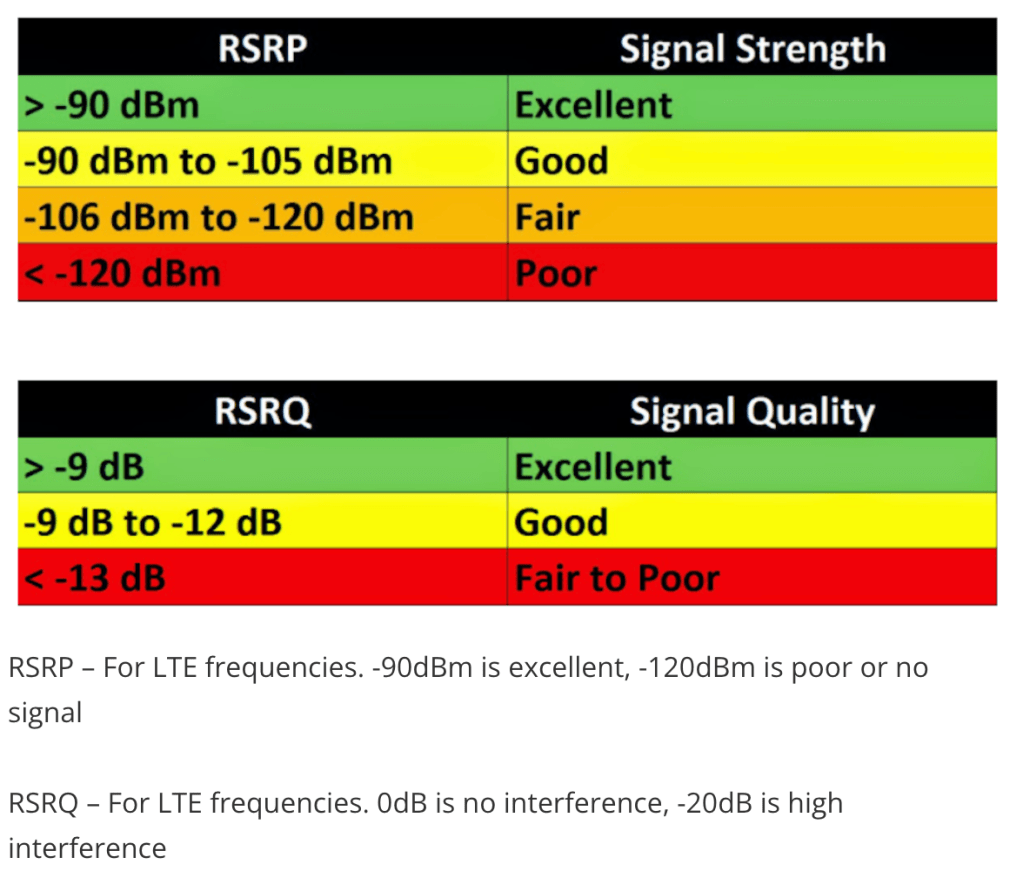
- Cell Signal Strength is best measure by RSRP (strength) and RSRQ (quality).
- RSRP is short for Reference Signal Received Power, used when measuring 4G LTE networks.
- A cellular phone or another LTE-equipped device would display signal strength in RSRP
- measured 0dBm (best signal) to -110dBm (weakest/no signal)
- An RSRP of -95dBm would be a strong signal whereas -115dBm would be very weak
- Many devices show RSSI for LTE connections along with RSRP, but RSRP is a better indicator of signal strength
- RSRQ is Reference Signal Received Quality.
- This again only applies to 4G LTE networks and is a measure of the signal quality of a cellular connection.
- RSRQ is typically displayed in a range from 0dB (highest quality) to -20dB (lowest quality).
- Typically better signal quality results in a more reliable connection.
- RSRP is short for Reference Signal Received Power, used when measuring 4G LTE networks.
- What is RAT vs. LTE?
- Radio Access Technology or (RAT) is the underlying physical connection method for a radio based communication network.
- Long-Term Evolution (LTE) is a standard for wireless broadband communication for mobile devices and data terminals
- Why is LTE RSRP frequently lower than RAT RSRP?
Bill of Materials
- Mobile Hot Spot
- Purpose: Mobile network connectivity based on cellular.
- Product: Verizon JetPack MiFi 8800L 4G LTE
- MIMO Antenna
- Purpose: to improve cellular signal strength to Hot Spot when nearer to a cellular tower.
- “near” to be defined.
- Product: 6000450 Netgear MIMO Antenna with 2 TS-9 Connectors
- Purpose: to improve cellular signal strength to Hot Spot when nearer to a cellular tower.
- Cellular Booster
- Purpose: to improve cellular signal strength to Hot Spot when further from a cellular tower.
- “further” to be defined.
- Product: 477154 Drive Reach OTR Booster
- Boosting in the RV
- Purpose: Power provided by outlet, Antenna is fixed to ladder.
- Products:
- 311229 Drive Reach OTR Outside Antenna
- 314401 Slim low-profile inside antenna
- 850029 Power Supply
- Boosting outside the RV
- Purpose: Power provided by 12V DC Power (Cigarette Lighter port), Antenna needs to be portable.
- Products:
- 311125 Wilson 12 Inch Magnet Mount Antennas
- 314401 Slim low-profile inside antenna
- 970019 SMA Female to SMB Plug Adaptor
- 850015 Wilson AC/DC 12V/1.8A Wall Power Supply
- Purpose: to improve cellular signal strength to Hot Spot when further from a cellular tower.
Performance Testing Cases & Results
- Test on available WiFi (if available)
- Test with only iPhone Cellular
- Test with only HotSpot Cellular
- Test with HotSpot + MIMO (when signal strength is not too weak)
- Test with HotSpot + weBoost + OTR Antenna (when in the RV)
- Test with HotSpot + weBoost + Magnet Antenna (when away from the RV)
Locations
- Elizabeth, Colorado – Suburban (EC)
- Tysons Corner, Virginia – Urban (TCV)
- Marquette, Michigan – Remote (MM)
| Location | HotSpot/MIMO/Boost | Download (mbps) | Upload (mbps) | Bars (4G LTE) | RSRP (Strength) | Date |
| EC | HotSpot | 91.0 | 6.82 | 3 | -104 dBm | 22-06-15 |
| EC | HotSpot+MIMO | 92.6 | 9.59 | 3 | -103 dBm | 22-06-15 |
| EC | HotSpot+weBoost+OTR | 62.8 | 16.7 | 3 | -100 dBm | 22-06-15 |
| EC | WiFi | 375.02 | 290.51 | – | -88dBm | 22-06-22 |
| TCV | iPhone (LTE) | 13.7 | 9.22 | 1 | -88 dBm | 22-06-28 |
| TCV | HotSpot | 5.94 | 13.67 | 1 | -88 dBm | 22-06-28 |
| TCV | HotSpot+MIMO | 4.63 | 20.95 | 2 | -88 dBm | 22-06-28 |
| MM | iPhone (LTE) | 1.63 | 0.66 | 3 | -98 dBm | 22-07-11 |
| MM | HotSpot | 3.08 | .54 | 3 | -104 dBm | 22-07-11 |
| MM | HotSpot+MIMO | 14.67 | 1.42 | 4 | -104 dBm | 22-07-11 |
Performance Testing Observations
- iPhone is faster in urban areas
- HotSpot is faster in suburban and remote areas
- MIMO boosts speeds in suburban and remote areas
- weBoost boosts speeds in remote areas
Metrics
- https://www.speedtest.net/
- weboost iphone app
- netanalyzer iphone app
- opensignal iphone app
References
 david marcus